“Hi, I saw that your pharmacy offers birth control prescribing. When can I meet with the pharmacist? Is there a fee?”
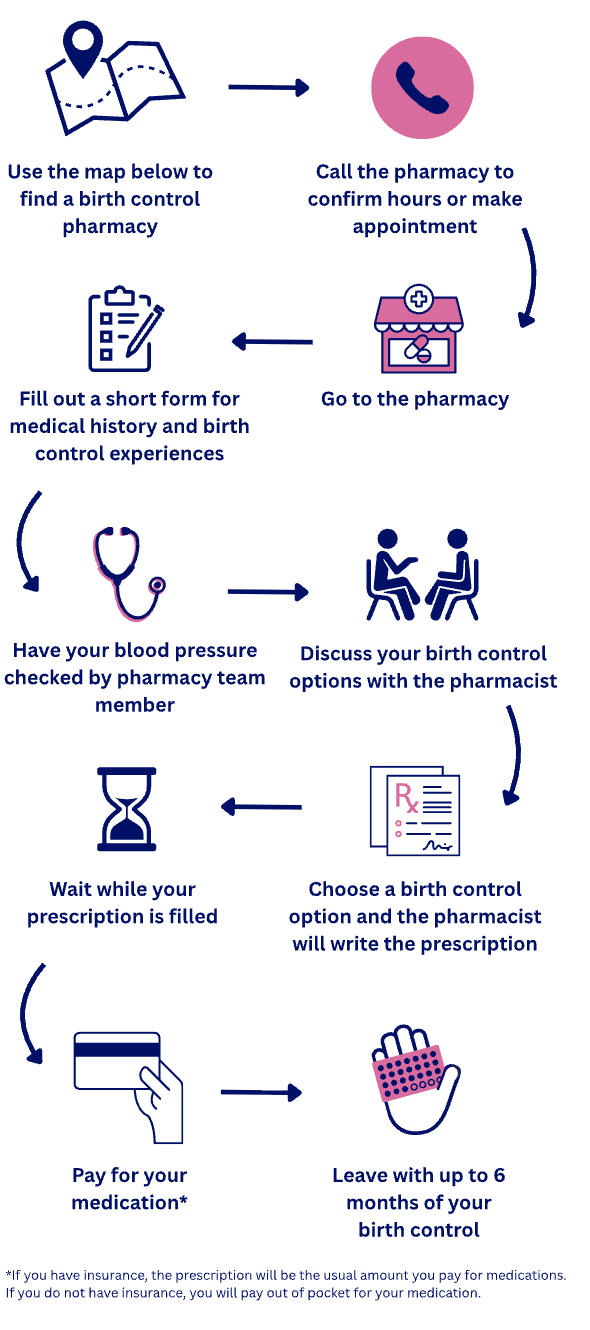
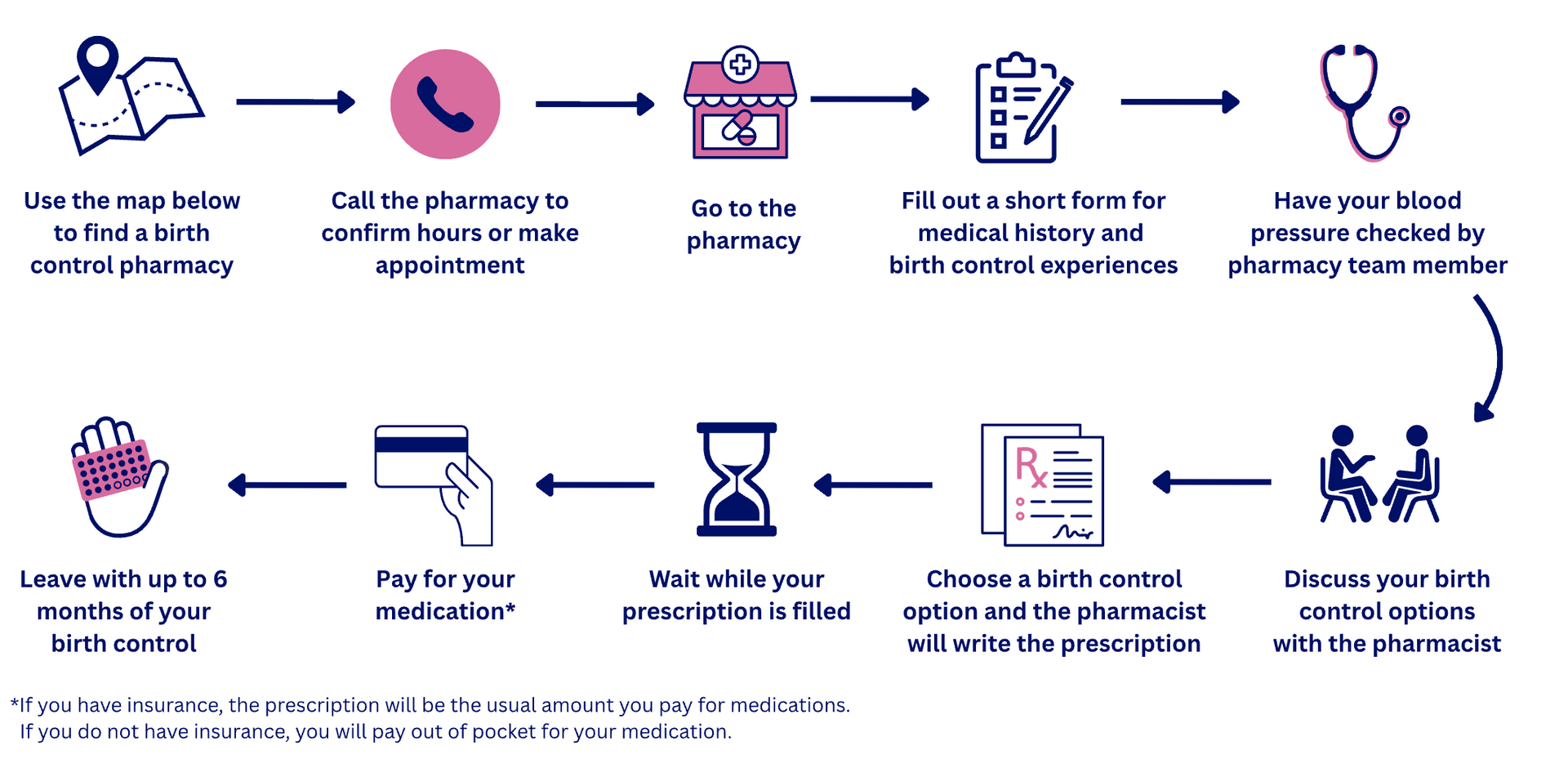
HOW TO GET BIRTH CONTROL AT THE PHARMACY IF YOU ARE 18 YEARS OR OLDER:
LOOKING FOR BIRTH CONTROL?
Pharmacists in Indiana can write a prescription for birth control if you are 18 years or older.
Find a pharmacy near you!
Are we missing a birth control pharmacy? Submit info here.
WHAT TO SAY WHEN CALLING THE PHARMACY

FREQUENTLY ASKED QUESTIONS
Is it safe for pharmacists to prescribe birth control?
Yes! There has been a lot of research in the US and other countries to show that this type of access to birth control is safe. In fact, more than 30 states currently allow pharmacists to prescribe birth control. Many people benefit from getting birth control from a pharmacist – like people who might have a hard time getting into another provider because of limited hours, transportation, or long wait times for appointments.
Is pharmacist prescribing the same as over the counter (OTC) birth control?
No. Over the counter (OTC) birth control methods do not contain estrogen and can be purchased without a prescription. If you prefer a method that includes estrogen, a brief health consultation with a pharmacist or health care provider is required to obtain a prescription. If you’re unsure which option best fits your needs and goals, your pharmacist or health care provider can help you choose.
What birth control is available from pharmacists?
In Indiana, pharmacists can prescribe hormonal methods that the patient gives to themselves. This includes birth control pills, patches, vaginal rings, and some types of the shot. Most pharmacies also carry other types of birth control, like condoms.
Is the birth control covered by insurance when prescribed by a pharmacist?
Yes. If you have insurance, the pharmacist will be able to bill the insurance just like a prescription by any health care provider.
How much does it cost to see a pharmacist for birth control?
The cost of the visit may be covered by your insurance, or you may be asked to pay a fee to see the pharmacist. Make sure to ask the pharmacy when you call to learn more.
Do I need a pelvic exam or Pap smear before getting birth control from the pharmacist?
No, you do not need a pelvic exam or Pap smear to get birth control from the pharmacist.
It is important to see your doctor for routine screenings to keep you healthy. It is recommended that most people with a cervix get a Pap smear to screen for cervical cancer every 3 years, starting at age 21.
If you get an IUD or diaphragm, your doctor may need to do a pelvic exam to make sure those methods are safe for you.
How does birth control work?
Birth control that contains two hormones (estrogen and progestin) stop your ovaries from releasing eggs, make the mucus in your cervix too thick for sperm to pass through, and thin the lining inside the uterus.
Birth control that contains one hormone (progestin) makes the mucus in your cervix too thick for sperm to pass through and thins the lining inside the uterus. Sometimes, it stops your ovaries from releasing eggs.
Can you get pregnant on birth control?
It is possible to still get pregnant while on birth control. An average of 7 out of 100 people get pregnant each year while taking a hormonal birth control.
What is ovulation?
Ovulation is when your ovary releases an egg. If you don’t ovulate, you cannot get pregnant. For most people, this usually happens around day 14 of your cycle (14 days after the first day of your period) if you aren’t taking birth control.
Do you ovulate on birth control?
If you are taking a birth control that contains estrogen, this usually stops ovulation. It is possible to ovulate if you are using a progestin-only birth control.
How long does birth control take to work?
Most forms of hormonal birth control start working after you have used them correctly for 7 days in a row. It is important to use another method of birth control, like a condom, if you have sex in the first 7 days of using hormone containing birth control.
How can I get birth control?
Many types of birth control require a prescription. You can see a trained pharmacist or other medical provider to get a prescription. There are some methods that are available over the counter without a prescription, like O-pill, condoms, and emergency contraception.
When should I start birth control?
You can start birth control at any time you are not likely to be pregnant. Some people like to wait to start birth control until their next period starts.
How will I know if my birth control is working?
As long as you are taking the birth control method consistently in the way it is supposed to be taken, it is working. No tests are needed to check.
How long will my period last while on birth control?
For many people, their periods become lighter and shorter while taking birth control. With some methods – like the shot – over time you may not have a period anymore. With other methods – like the pill – your period might last 2-5 days.
What can I expect when stopping birth control?
Pill, Patch, Ring – you can get pregnant right away after you stop birth control. If you do not want to be pregnant, consider using a different birth control method like condoms (available at the pharmacy) or an intrauterine device (IUD) or implant, which are available from your doctor’s office.
Shot – you can get pregnant right away after you stop taking the birth control shot. Some people do not get pregnant right away after stopping the shot. On average, it takes about 10 months to start ovulation after stopping the shot. If you want to be pregnant within the next year, talk to your pharmacist about using a different type of birth control.
What happens if I miss a birth control pill?
Combined Birth Control Pill (estrogen and progestin)
- If you missed one pill, take the pill as soon as possible. Continue taking the remaining pills at the usual time, even if it means taking two pills on the same day. No additional birth control method is needed.
- If you missed 2 pills in a row (48 or more hours since a pill should have been taken), take the most recent pill as soon as possible. Discard any other missed pills. Continue taking the remaining pills at the usual time, even if it means taking two pills on the same day. Use a barrier method like condoms until the pills have been taken correctly for 7 days in a row. Consider using emergency contraception if the pills were missed during the first week of your pack and you had unprotected sexual intercourse during the last 5 days.
Progestin-only Birth Control Pill
- Norethindrone or norgestrel – If one pill is missed (more than 3 hours since a pill should have been taken) take the pill as soon as possible. Continue taking pills daily at the same time each day, even if it means taking two pills on the same day. Use a barrier method like condoms until the pills have been taken correctly, on time, for two days in a row. Consider using emergency contraception if you have had unprotected sexual intercourse.
- Slynd (drosperinone) - If one pill is missed, take the pill as soon as possible. Continue taking one pill a day until the pack is finished. No additional birth control is needed. If two pills are missed in a row (48 hours or more since a pill should have been taken), take the most recent pill as soon as possible. Discard any other missed pills. Continue taking the remaining pills at the usual time, even if it means taking two pills on the same day. Use a barrier method like condoms until the pills have been taken correctly for 7 days in a row. Consider using emergency contraception if the pills were missed during the first week of your pack and you had unprotected sexual intercourse during the last 5 days.
What are the side effects of birth control?
If you are using a progestin-only pill, you may have more bleeding between periods and menstrual changes compared to the combined progestin and estrogen pill.
If you are using a combined birth control that contains both a progestin and estrogen, you will feel about the same. Common side effects are nausea in the first few months, bleeding between periods, and/or breast discomfort. These problems generally go away after 2-3 months. Some people are concerned about weight gain. This is uncommon with the pill. Some people report a change in their mood or headaches. These can be better or worse. If your headaches get worse, let your pharmacist or doctor know. There is a small risk of developing a blood clot when taking estrogen containing birth control. This risk is uncommon and is something the pharmacist will check for before prescribing birth control.
If you are using the progestin-only shot, many people have bleeding between periods and after the first 2-3 shots, you may have no period at all. Some people may feel hungrier and may gain weight while on the shot. Some people report a change in acne, mood, or headaches. These can be better or worse. Long-term use of the shot may lead to lower bone density, which improves after stopping the shot. If you do not get enough calcium in your diet, some providers will recommend calcium/vitamin D supplements.
I want an intrauterine device (IUD) or implant for birth control, but I can’t get an appointment with my doctor soon. What should I do?
You can take the pill, patch, ring, or shot for birth control until you are able to see your doctor. Your pharmacist can prescribe enough birth control to cover you until your appointment.
I don’t have a doctor. Where can I go for an appointment?
Find a provider near you:
- Title X: Indiana Family Health Council
- Title X Family Planning Clinic Locator
- Bedsider Clinic Locator
- Path4You Contraception Services
- Younger Person Contraception Services
- Planned Parenthood Health Center Locator
- Planned Parenthood Abortion Services
- National AbortionFinder
- PlanCPills.org
Does birth control protect against sexually transmitted infections (STIs), also known as sexually transmitted diseases (STDs)?
No, birth control with hormones does not protect against STIs or HIV. To protect yourself against STIs and HIV, use a barrier method like a condom every time you have sex.
PrEP is a medication that, when taken daily, is effective at protecting a person from getting HIV. For more information about PrEP and to connect to a PrEP Navigator, visit https://prepdaily.org/
I’m worried I might have a sexually transmitted infection (STI), where can I go to get tested?
Find an STI Testing Center:
- Indiana Department of Health (IDOH) STI Prevention Program
- IDOH STI Testing Clinic Locator
- Bellflower Free STI Testing for Marion County
- HIV PrEP Provider Locator
- CDC Testing Directory